
Hot Metal
Three things worth your attention this week.
The ROI numbers are doing the talking — check the baseline. The 2026 steel-digitalization decks are quoting 200-500% ROI inside eighteen months, 30-50% cuts in unplanned downtime — 85% in the boldest case study — and $3-10M in annual savings. It's the same question we put to the electrode salesman a few issues back: reduction from what baseline? A 50% downtime cut off a run-to-failure shop is real; off a shop already running disciplined planned maintenance, that number quietly shrinks to something you'd never sign a capital request for.
Digital twins are real on the spinning and the electrical, thin everywhere else. Published benchmarks cluster around 20% fewer unplanned stoppages, roughly 10% lower scheduling labor, and low-single-digit revenue uplift. Those gains hold on transformers, drives, and rotating equipment — assets with measurable, trendable degradation. On refractory and consumables, the twin mostly tells a good shift crew what they already know from the back of the panel.
Tenaris just showed where reliability money actually goes — into the furnace. Announced June 30, Tenova will engineer, supply, and commission an EAF revamp at the Koppel, Pennsylvania mill, part of a $90M+ program across Koppel and Ambridge aimed at productivity, reliability, and safeguarding critical equipment. Read the order of operations: when the consequence sits in the asset, you harden the asset first. The dashboard comes after — which happens to be this week's whole argument.
Where predictive maintenance actually returns the investment
Predictive maintenance gets sold as a plant-wide platform. It pays as a short list of assets. The gap between those two framings is most of the disappointment we've watched shops walk into — they instrument everything, generate dashboards nobody acts on, and conclude "PdM doesn't work here." It works fine. They pointed it at the wrong assets.
The honest filter is two questions per asset: does it fail in a way you can see coming, and does that failure cost you a heat — or a quarter? Strong ROI lives where both answers are yes.
Where it pays:
The furnace transformer. Failure is catastrophic, replacement lead times are brutal, and the degradation is genuinely trendable — thermal signatures, dissolved-gas analysis, busbar and connection integrity. A single prevented transformer outage typically returns the entire program cost. This is the anchor case; if you do nothing else, do this.
Reformer tubes on the DRI side. Creep and overheating are progressive and measurable, and a tube failure is both dangerous and schedule-wrecking. Temperature mapping and trending here buys you planned replacement instead of a forced outage — the highest-stakes prediction in the shop.
Electrode arm hydraulics and regulation. Seal wear and cylinder drift show up in pressure and response data before they show up as a missed bore-in or a broken electrode. Cheap to monitor, direct line to consumption and uptime.
Rotating equipment — fans, pumps, gearboxes. Vibration monitoring is the oldest, most proven PdM there is. Unglamorous, reliably positive.
Where it doesn't, or barely:
Refractory and the vessel. Degradation is real, but the failure modes are too variable and the existing tools — thermography, a good operator's read of the shell — already capture most of the signal. Layering an AI twin on top rarely changes the reline decision you'd have made anyway.
EBT and consumables. Episodic, replaced on a known cycle. Predicting a consumable is mostly counting heats; you don't need a model for that.
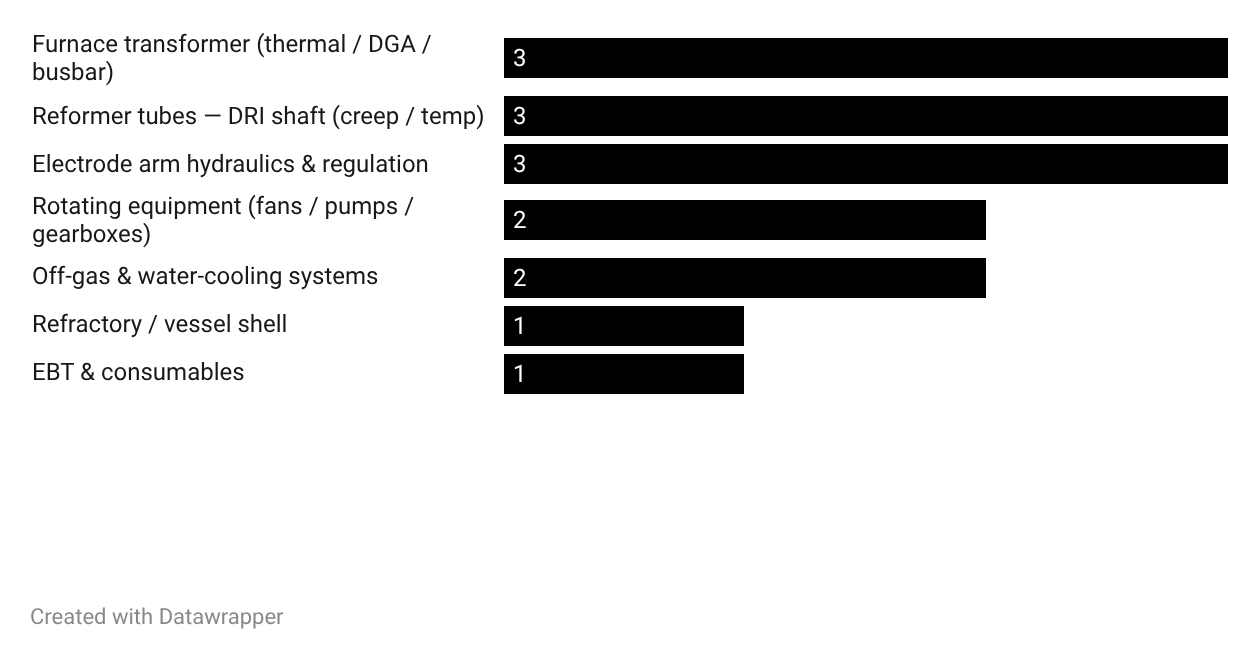
The chart ranks the major asset classes by where the payoff actually sits — failure consequence times predictability. Treat it as an operator's starting map, not gospel: your shop's weak points may rank differently, and that's the point. The ROI is in matching the tool to the asset, not in coverage.
One more honest note on the vendor math. The headline ROI figures assume you're replacing a reactive, run-to-failure baseline. If your maintenance is already disciplined — planned outages, condition rounds, a crew that listens to the furnace — the marginal gain from a platform is real but far smaller than the deck claims. Buy PdM to harden your three highest-consequence assets, not to buy a number off a slide.
Operator's Notebook — 12-question PdM data-readiness check
PdM fails on data foundations more often than on algorithms. Answer yes/no from what your plant actually has today. (This is the seed for our subscriber Dashboard Audit — the broader version covers cost and process too.)
Sensing & signal
Is the furnace transformer instrumented for thermal + DGA + connection integrity, with the data logged, not just alarmed?
Are reformer-tube temperatures mapped and trended over time (DRI shops)?
Is there vibration monitoring on critical rotating equipment?
Do electrode-arm hydraulics log pressure/response per heat?
Data plumbing
Is there a data historian, and is your sample rate fast enough to catch the failure modes that matter?
Are assets identified consistently enough to join sensor data to maintenance history?
Do failures get coded with a cause, not just "fixed"?
Is at least a year of history retained — enough to train anything?
Action loop
Do predictive alerts create a CMMS work order, or just an email someone ignores?
Is there a named owner who acts on PdM flags each shift?
Are outages scheduled against the prediction, or against the calendar?
Can you point to one failure PdM actually caught — or is it still a slide?
Scoring: 10-12 yes — ready to scale. 6-9 — fix the plumbing before buying more sensors. 0-5 — start with the transformer and a historian, nothing else.
Next week: the real cost of a delay — what an hour off-power actually does to your bill.
Written by active DRI-EAF operators. Anonymous by necessity, specific by design.